

Leonardo AI Review:
Is It Worth It in 2026?
Leonardo AI is best suited for designers and professionals who want flexible AI image generation with a genuinely usable free tier — offering daily generation credits, customizable and fine-tuned models, and controllable outputs for concept art, product visualization, and marketing imagery.
Best For
Our Overall Rating
Based on comprehensive testing
Best For
- Designers who want image generation with more control than one-shot prompt tools
- Professionals producing product visualization and marketing imagery on a budget
- Teams that want a consistent look via fine-tuned or custom-trained models
- Anyone who wants to test AI image generation seriously on a free tier first
Pricing
See current pricing on the Leonardo AI website.
Bottom Line
Leonardo AI is best suited for designers and professionals who want flexible AI image generation with a genuinely usable free tier — offering daily generation credits, customizable and fine-tuned models, and controllable outputs for concept art, product visualization, and marketing imagery.
Visit Leonardo AI →Quick Verdict
Leonardo AI scores 8.6/10 in our testing and is a strong choice for Designers who want image generation with more control than one-shot prompt tools and Professionals producing product visualization and marketing imagery on a budget. A free tier is available.
What Is Leonardo AI?
Overview
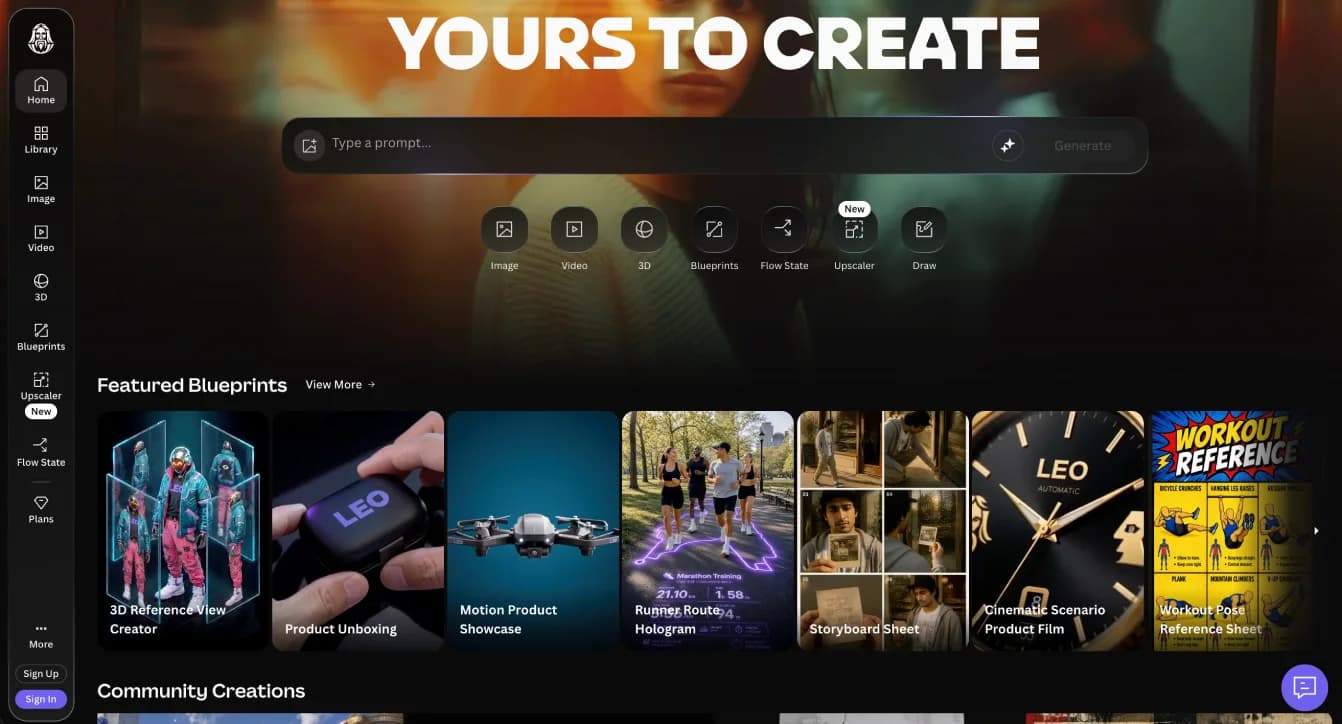
Leonardo AI is an AI image-generation platform aimed at users who want more control and flexibility than a single prompt box provides. Alongside standard text-to-image generation, it offers a large library of fine-tuned models, the ability to train custom models for a consistent style, and controls that guide how closely outputs follow a reference.
Its most distinctive trait is a genuinely usable free tier: daily generation credits let designers and professionals experiment seriously before paying, which lowers the barrier to adopting AI imagery into a real workflow.
This review evaluates Leonardo AI based on its output quality, control, free-tier value, and practical fit for professionals producing concept and marketing imagery in 2026.
Key Features
Fine-Tuned and Custom Models
Leonardo AI ships with a broad library of fine-tuned models for different styles and subjects, and lets users train their own — useful when a project needs a consistent look across many images.
Controllable Generation
Beyond one-shot prompting, Leonardo offers image guidance and prompt controls that steer outputs toward a reference or composition, giving more predictable results for professional work.
Free Tier with Daily Credits
A daily allowance of generation credits makes the free tier practical for regular experimentation, so teams can evaluate the tool on real tasks before committing to a paid plan.
Product and Concept Imagery
The combination of control and model variety makes Leonardo strong for product visualization, concept art, and marketing imagery — the kinds of visuals professionals across design-led industries need.
Pros & Cons
Pros
- ✅ Genuinely usable free tier with daily generation credits for regular experimentation
- ✅ Large library of fine-tuned models plus the option to train your own for a consistent look
- ✅ Fine-grained control over outputs (image guidance, prompt controls) beyond one-shot prompting
- ✅ Strong for product visualization, concept art, and marketing imagery across industries
Cons
- ❌ More controls and model choices mean a steeper learning curve than one-click tools
- ❌ Free-tier daily credits can be limiting for high-volume or commercial workloads
- ❌ Like all generative image tools, outputs need review for accuracy and licensing before client use
- ❌ Not built for precise architectural geometry — it's stylistic imagery, not model-accurate rendering
Who Is It Best For?
Leonardo AI is the right tool if you:
- Want control over image generation beyond a single prompt, including guidance and model choice
- Produce product or marketing imagery and want a consistent style via fine-tuned models
- Prefer to evaluate on a free tier with daily credits before paying
- Need flexibility across concept art, visualization, and marketing visuals
Leonardo AI is not the right tool if you:
- Need model-accurate architectural rendering rather than stylistic imagery
- Want the absolute simplest one-click experience with no settings to learn
- Have high-volume commercial needs that a daily free-credit allowance can't cover
Alternatives to Consider
Leonardo AI is flexible and free-tier-friendly, but it is not the only option:
- Midjourney — often the aesthetic benchmark, but less granular control and no free tier
- Adobe Firefly — best for those already in the Adobe ecosystem, with a focus on commercial-safe training
- DALL-E — strong prompt adherence via ChatGPT, with fewer fine-tuning options
- Canva AI — easiest for non-designers who want image generation inside a broader design workflow
- Stable Diffusion — maximum control and local/self-hosted options, but more technical to run
Final Verdict
Leonardo AI earns its place for professionals who want AI image generation with real control — fine-tuned models, custom training, and guidance over outputs — without giving up an accessible free tier to learn on. For product visualization, concept art, and marketing imagery, that mix of flexibility and low entry barrier is a strong combination.
The trade-off is complexity: more knobs than a one-click tool, and free-tier limits that a high-volume workflow will outgrow. For precise architectural rendering, it's the wrong category entirely — this is stylistic imagery, not model-accurate output.
Our recommendation: Start on the free tier and put Leonardo AI through a real project — train or pick a model for your desired style and test the controls — before deciding whether its flexibility justifies a paid plan over a simpler tool like Midjourney.
Key Features
Genuinely usable free tier with daily generation credits for regular experimentation
Large library of fine-tuned models plus the option to train your own for a consistent look
Fine-grained control over outputs (image guidance, prompt controls) beyond one-shot prompting
Strong for product visualization, concept art, and marketing imagery across industries
Best For
Designers who want image generation with more control than one-shot prompt tools
Professionals producing product visualization and marketing imagery on a budget
Teams that want a consistent look via fine-tuned or custom-trained models
Anyone who wants to test AI image generation seriously on a free tier first
Pros & Cons
What We Like
- Genuinely usable free tier with daily generation credits for regular experimentation
- Large library of fine-tuned models plus the option to train your own for a consistent look
- Fine-grained control over outputs (image guidance, prompt controls) beyond one-shot prompting
- Strong for product visualization, concept art, and marketing imagery across industries
What We Don't Like
- More controls and model choices mean a steeper learning curve than one-click tools
- Free-tier daily credits can be limiting for high-volume or commercial workloads
- Like all generative image tools, outputs need review for accuracy and licensing before client use
- Not built for precise architectural geometry — it's stylistic imagery, not model-accurate rendering
Top Leonardo AI Alternatives
View all alternatives →
Midjourney
Alternative to Leonardo AI
Read Review →
Adobe Firefly
Alternative to Leonardo AI
Read Review →DALL-E
Alternative to Leonardo AI

Canva AI
Alternative to Leonardo AI
Read Review →Stable Diffusion
Alternative to Leonardo AI
Leonardo AI vs Top Alternatives
| Tool | Best For | Price | AI Quality | Features | Support | Ease of Use | Rating | |
|---|---|---|---|---|---|---|---|---|
 | Designers who want image generation with more control than one-shot prompt tools | Contact for pricing | 8.6/10 | Current | ||||
 | Cross-niche | Contact for pricing | 8.1/10 | Read Review → | ||||
 | Cross-niche | Contact for pricing | 7.8/10 | Read Review → | ||||
D DALL-E | Cross-niche | Contact for pricing | 7.5/10 | — | ||||
 | Cross-niche | Contact for pricing | 7.2/10 | Read Review → |
Our Leonardo AI Verdict
Leonardo AI is best suited for designers and professionals who want flexible AI image generation with a genuinely usable free tier — offering daily generation credits, customizable and fine-tuned models, and controllable outputs for concept art, product visualization, and marketing imagery.
Free plan available
FAQ
Related Articles
View all articles →Best AI Design Tools for Professionals in 2026
Discover the top AI tools we recommend in AI Design Tools.
View Hub →Leonardo AI vs Top Alternatives: Full Comparison
Side-by-side breakdown of Leonardo AI and its main competitors.
View Comparisons →Hands-on Guides & Workflows
Step-by-step playbooks for getting the most out of tools like Leonardo AI.
Browse Guides →Related Tools in AI Design Tools
See all the best AI Design Tools →
Marxent
Marxent is best suited for furniture manufacturers and retailers who need enterprise-grade 3D product configuration, augmented reality, and room planning tools integrated into their e-commerce and sales channels — particularly brands with complex product lines and modular or custom furniture.
Read Review →
Zakeke
Zakeke is best suited for small-to-mid-size furniture brands selling on Shopify, WooCommerce, or similar platforms who need an accessible 3D product configurator and AR visualization tool without the enterprise implementation scope of platforms like Marxent or Threekit.
Read Review →
Chaos Envision
Chaos Envision is best suited for architecture and design teams who need to conduct collaborative VR design reviews with clients and stakeholders — enabling multiple participants to enter a 3D model simultaneously and discuss design decisions in an immersive environment.
Read Review →
QR Code AI
QR Code AI is best suited for furniture retailers, real estate agents, and contractors who want branded, on-style QR codes for signage, listings, and print materials instead of generic black-and-white squares.
Read Review →