

STACK Review:
Is It Worth It in 2026?
STACK is best suited for contractors, subcontractors, and estimating teams who need a fast, cloud-based takeoff and estimating platform to measure quantities from digital drawings, build cost estimates, and manage bid packages — all in a single shareable workspace.
From
From $2,599/year
Best For
Our Overall Rating
Based on comprehensive testing
Best For
- General contractors managing multiple concurrent bids who need a shared estimating platform
- Specialty subcontractors needing digital takeoff without investing in expensive enterprise software
- Estimating teams that collaborate across offices or remote locations on project bids
- Contractors wanting to move from spreadsheet estimating to a purpose-built platform
Pricing
Starts at
Bottom Line
STACK is best suited for contractors, subcontractors, and estimating teams who need a fast, cloud-based takeoff and estimating platform to measure quantities from digital drawings, build cost estimates, and manage bid packages — all in a single shareable workspace.
Visit STACK →Quick Verdict
STACK scores 8.6/10 in our testing and is a strong choice for General contractors managing multiple concurrent bids who need a shared estimating platform and Specialty subcontractors needing digital takeoff without investing in expensive enterprise software. A free tier is available, with paid plans from From $2,599/year.
What Is STACK?
Overview
STACK is a cloud-based construction takeoff and estimating platform that helps contractors, subcontractors, and estimating teams measure quantities from digital drawings and build cost estimates in a collaborative, browser-based workspace. Founded before the current wave of AI construction tools, STACK established itself as a practical digital replacement for paper-based or spreadsheet-based takeoff workflows, with a strong focus on ease of use and team collaboration.
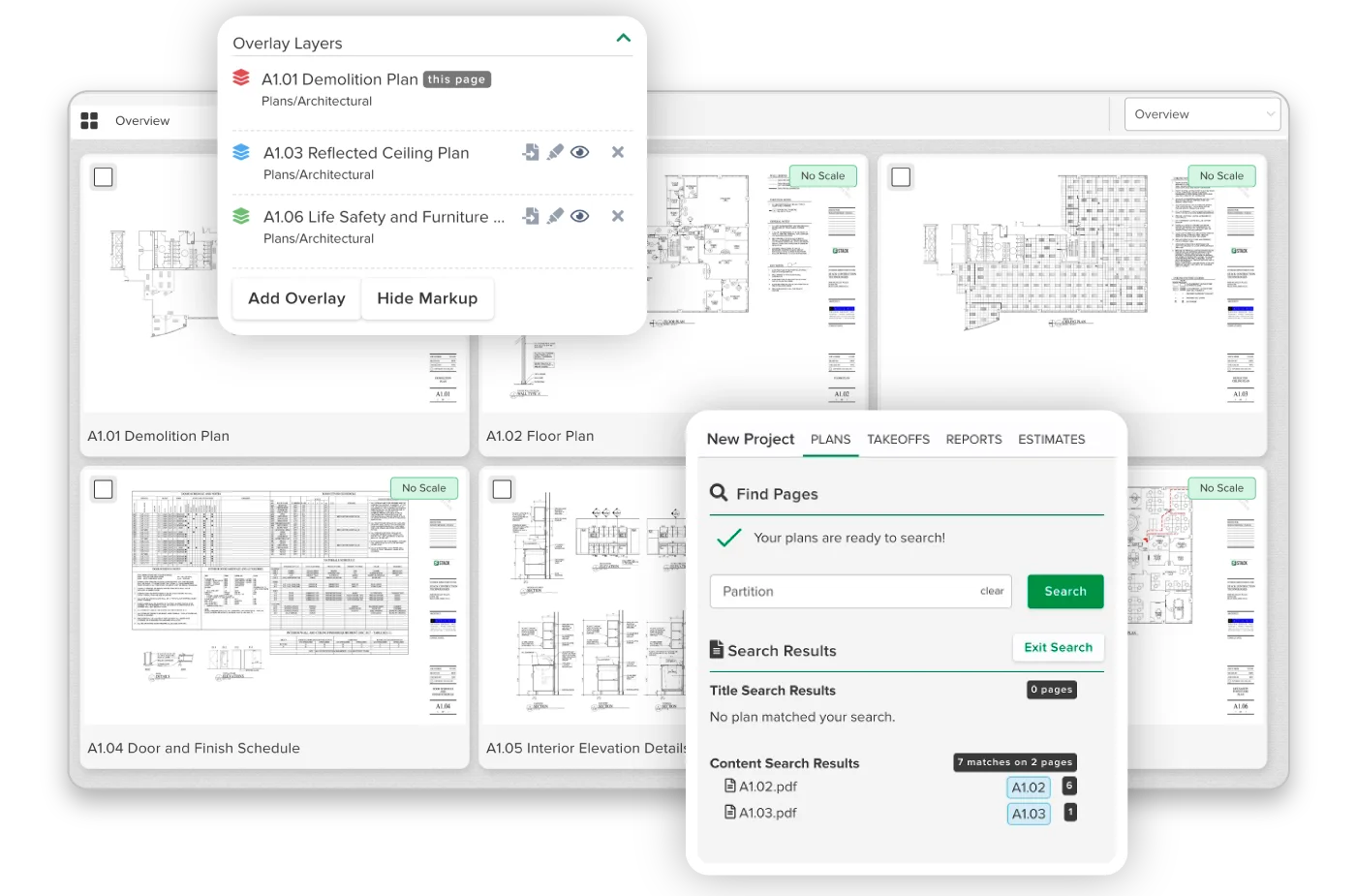
The platform covers the core preconstruction workflow: uploading drawings, performing digital measurements, applying pricing from cost databases or custom assemblies, and organizing completed estimates into bid packages. Its cloud-based architecture makes it particularly useful for teams collaborating across locations or managing bid volume that exceeds what a single estimator can handle alone.
This review evaluates STACK based on its takeoff capabilities, collaboration features, and practical fit for construction estimating workflows in 2026.
Key Features
Digital Takeoff Tools
STACK provides a full set of digital measurement tools — linear, area, count, and volume — applied directly to uploaded PDF drawings in the browser, replacing the manual process of scaling and measuring paper prints with faster, more accurate digital measurement.
Cloud Collaboration
The platform's cloud-based architecture allows multiple estimators to work on the same project simultaneously, share takeoffs with project owners or subcontractors, and maintain a single version of each estimate without managing file versions.
Cost Database Integration
STACK integrates with industry cost databases and allows teams to build custom cost assemblies, enabling a workflow from quantity measurement to fully priced estimate within the same platform.
Bid Management
Beyond individual estimates, STACK includes bid management features for tracking invited subcontractors, managing proposal deadlines, and organizing the full bid package for a project.
Pros & Cons
Pros
- ✅ Cloud-based platform enables real-time collaboration on takeoffs and estimates across teams
- ✅ Digital takeoff tools significantly faster than manual measurement on paper drawings
- ✅ Cost database integrations allow moving from quantity measurement to cost estimate in one workflow
- ✅ Bid management features help track and organize multiple concurrent project bids
Cons
- ❌ AI automation is less advanced than newer AI-first takeoff tools like Kreo or Togal AI
- ❌ Feature depth may exceed what smaller contractors or single-person estimating operations need
- ❌ Pricing can be a barrier for smaller subcontractors who bid a limited number of projects
- ❌ Learning curve for teams transitioning from spreadsheet-based or paper-based estimating
Who Is It Best For?
STACK is the right tool if you:
- Manage multiple concurrent bids and need a shared, cloud-based estimating workspace for your team
- Want to replace paper or spreadsheet takeoff with a purpose-built digital platform
- Need bid management features alongside takeoff — not just measurement, but full bid organization
- Collaborate across locations and need estimators to work on the same project simultaneously
STACK is not the right tool if you:
- Want AI-automated takeoff that reduces measurement time further than digital tools alone
- Are a very small contractor who bids a handful of projects per year where the investment doesn't pay off
- Need deep project management features beyond preconstruction estimating
Alternatives to Consider
- Kreo — AI-powered takeoff with more automation for quantity extraction from drawings
- Togal AI — AI-first takeoff tool focused on automated measurement from 2D drawings
- PlanSwift — established desktop takeoff software with a large contractor user base
- Buildxact — estimating platform targeting smaller construction businesses with simpler pricing
- ProEst — cloud estimating platform with stronger project management integration for larger contractors
Final Verdict
STACK occupies a solid position in the construction estimating software market — more capable and collaborative than spreadsheet-based approaches, more accessible and affordable than heavy enterprise systems. For contractor teams that have outgrown manual workflows but aren't ready for the complexity or cost of enterprise construction software, it's a practical upgrade.
As AI-first takeoff tools mature and close the price gap, STACK's relative lack of AI automation becomes more notable. But for teams whose primary need is digital measurement and collaborative estimating rather than full AI automation, it remains a dependable platform.
Our recommendation: Evaluate STACK alongside one AI-first takeoff tool like Togal AI on the same set of test drawings — the comparison will reveal whether the AI automation savings justify the switch, or whether STACK's broader estimating workflow features better match your team's needs.
Key Features
Cloud-based platform enables real-time collaboration on takeoffs and estimates across teams
Digital takeoff tools significantly faster than manual measurement on paper drawings
Cost database integrations allow moving from quantity measurement to cost estimate in one workflow
Bid management features help track and organize multiple concurrent project bids
Best For
General contractors managing multiple concurrent bids who need a shared estimating platform
Specialty subcontractors needing digital takeoff without investing in expensive enterprise software
Estimating teams that collaborate across offices or remote locations on project bids
Contractors wanting to move from spreadsheet estimating to a purpose-built platform
Pros & Cons
What We Like
- Cloud-based platform enables real-time collaboration on takeoffs and estimates across teams
- Digital takeoff tools significantly faster than manual measurement on paper drawings
- Cost database integrations allow moving from quantity measurement to cost estimate in one workflow
- Bid management features help track and organize multiple concurrent project bids
What We Don't Like
- AI automation is less advanced than newer AI-first takeoff tools like Kreo or Togal AI
- Feature depth may exceed what smaller contractors or single-person estimating operations need
- Pricing can be a barrier for smaller subcontractors who bid a limited number of projects
- Learning curve for teams transitioning from spreadsheet-based or paper-based estimating
Top STACK Alternatives
View all alternatives →
Kreo
Alternative to STACK
Read Review →
Togal AI
Alternative to STACK
Read Review →
PlanSwift
Alternative to STACK
Read Review →Buildxact
Alternative to STACK
ProEst
Alternative to STACK
STACK vs Top Alternatives
| Tool | Best For | Price | AI Quality | Features | Support | Ease of Use | Rating | |
|---|---|---|---|---|---|---|---|---|
 | General contractors managing multiple concurrent bids who need a shared estimating platform | From $2,599/year | 8.6/10 | Current | ||||
 | Construction | Contact for pricing | 8.1/10 | Read Review → | ||||
 | Construction | Contact for pricing | 7.8/10 | Read Review → | ||||
 | Construction | Contact for pricing | 7.5/10 | Read Review → | ||||
B Buildxact | Construction | Contact for pricing | 7.2/10 | — |
Our STACK Verdict
STACK is best suited for contractors, subcontractors, and estimating teams who need a fast, cloud-based takeoff and estimating platform to measure quantities from digital drawings, build cost estimates, and manage bid packages — all in a single shareable workspace.
Free plan available
FAQ
Related Articles
View all articles →Best AI Tools for Construction in 2026
Our editorial guide to the AI tools we recommend, including STACK.
Read Guide →STACK vs Top Alternatives: Full Comparison
Side-by-side breakdown of STACK and its main competitors.
View Comparisons →Hands-on Guides & Workflows
Step-by-step playbooks for getting the most out of tools like STACK.
Browse Guides →Head-to-Head Comparisons
Related Tools in Construction
See all the best Construction →
StructionSite
StructionSite is best suited for general contractors and project teams that need systematic photo and 360-video documentation of construction sites — using AI to track installed work, verify progress against plans, and create a searchable visual record of the entire build.
Read Review →
Beam AI
Beam AI is best suited for construction estimators and contractors who want finished, reviewed takeoffs rather than raw AI output — combining AI quantity extraction with human QA to deliver estimate-ready quantities aligned to their own formats and pricing logic.
Read Review →
Mastt
Mastt is best suited for project owners, project managers, and owner's representatives on capital projects who want to control cost, contracts, payments, and reporting in one system — using AI to extract data from contracts and invoices and keep dashboards and forecasts current without spreadsheet rebuilds.
Read Review →
nPlan
nPlan is best suited for construction planners and project teams who want machine-learning schedule risk forecasting — predicting activity durations and flagging delay risks from patterns in historical project data, before those risks become issues on site.
Read Review →