

Kreo Review:
Is It Worth It in 2026?
Kreo is best suited for contractors, estimators, and construction firms who need to automate quantity takeoff from 2D drawings and BIM models — reducing the manual measurement time that traditionally makes estimating one of the most time-intensive parts of preconstruction.
From
From $35/user/month
Best For
Our Overall Rating
Based on comprehensive testing
Best For
- General contractors managing large project bids where takeoff volume is a bottleneck
- Estimating teams at mid-to-large construction firms that handle multiple concurrent bids
- Specialty contractors needing fast, accurate material quantity extraction from drawings
- Preconstruction departments wanting to reduce time from drawing receipt to estimate delivery
Pricing
Starts at
Bottom Line
Kreo is best suited for contractors, estimators, and construction firms who need to automate quantity takeoff from 2D drawings and BIM models — reducing the manual measurement time that traditionally makes estimating one of the most time-intensive parts of preconstruction.
Visit Kreo →Quick Verdict
Kreo scores 8.6/10 in our testing and is a strong choice for General contractors managing large project bids where takeoff volume is a bottleneck and Estimating teams at mid-to-large construction firms that handle multiple concurrent bids. Pricing starts at From $35/user/month.
What Is Kreo?
Overview
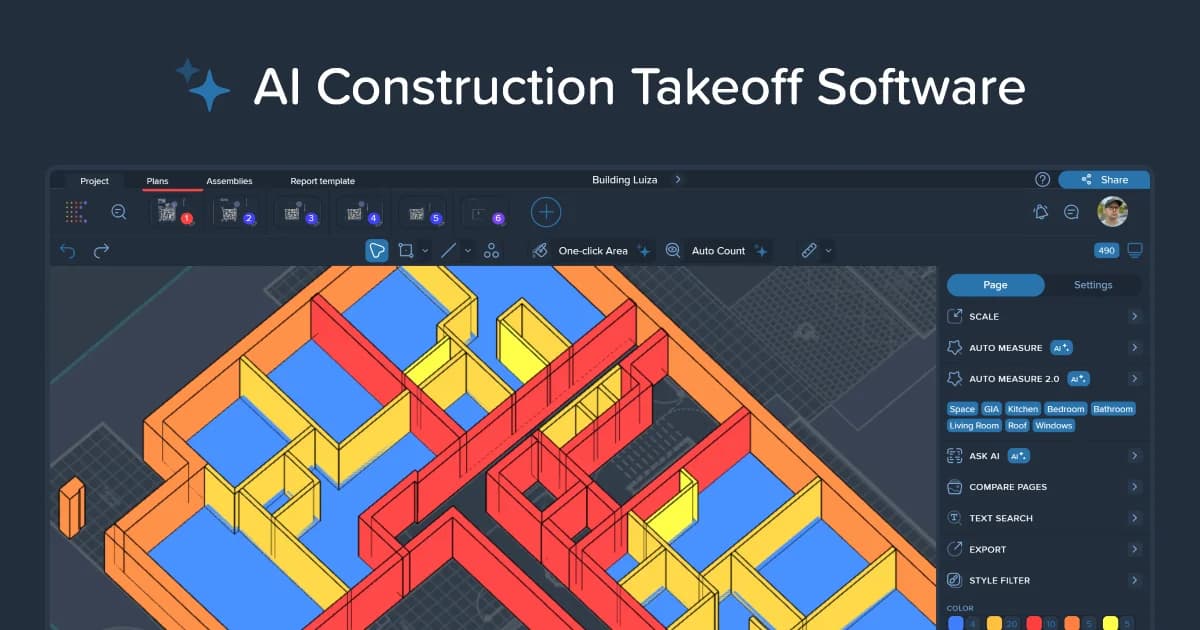
Kreo is an AI-powered construction estimating and quantity takeoff platform that automates the manual measurement process traditionally performed by estimators reviewing 2D drawings and 3D BIM models. By using AI to identify, classify, and measure building elements automatically, Kreo reduces the time required to produce quantity takeoffs — one of the most labor-intensive and error-prone parts of the preconstruction process.
The platform targets contractors and estimating teams who face pressure to turn around accurate bids faster, with less manual effort, across an increasing volume of projects. Kreo positions itself as a complement to estimators' expertise, handling the measurement burden so estimators can focus on pricing strategy and scope interpretation.
This review evaluates Kreo based on its takeoff accuracy, workflow integration, and practical fit for construction estimating teams in 2026.
Key Features
AI Quantity Takeoff from 2D Drawings
Kreo's core capability automatically identifies and measures building elements from 2D PDF construction drawings — walls, slabs, openings, finishes, and other elements — producing quantity lists that would otherwise require hours of manual measurement.
BIM Model Integration
For projects with 3D BIM models, Kreo can extract quantities directly from model geometry, leveraging the information already embedded in BIM files to produce faster, more comprehensive takeoffs without redoing measurement from 2D documents.
Cloud-Based Collaborative Estimating
The platform runs in the cloud, allowing estimating teams to work on the same project simultaneously, share takeoffs internally, and collaborate with subcontractors or owners without the file version management issues of desktop software.
Cost Database Integration
Kreo connects with standard construction cost databases and allows teams to apply pricing to extracted quantities, creating a path from takeoff to cost estimate within the same platform.
Pros & Cons
Pros
- ✅ AI automates quantity takeoff from 2D PDF drawings and 3D BIM models significantly faster than manual
- ✅ Cloud-based platform allows collaborative estimating across teams without file transfer friction
- ✅ Reduces human error in measurement that compounds into significant cost estimation inaccuracies
- ✅ Integrates with popular cost databases and estimation workflows for a complete preconstruction picture
Cons
- ❌ AI takeoff accuracy still requires estimator review — complex drawings with unusual geometry need verification
- ❌ Learning curve for teams transitioning from traditional manual or legacy software workflows
- ❌ AI-powered takeoff sits on a higher-priced tier, so per-user cost adds up across a larger estimating team
- ❌ BIM integration quality depends on model completeness and discipline coordination
Who Is It Best For?
Kreo is the right tool if you:
- Handle a high volume of bids where takeoff time is the primary constraint on how many projects you can pursue
- Want to reduce manual measurement errors that affect estimate accuracy and project profitability
- Manage an estimating team that would benefit from collaborative, cloud-based workflow rather than desktop-only tools
- Work with BIM models and want to extract quantities from 3D model data rather than 2D drawings alone
Kreo is not the right tool if you:
- Are a small contractor with low bid volume where manual takeoff time isn't a significant bottleneck
- Want AI-powered takeoff at the lowest possible cost, since the AI features sit on a higher tier
- Work primarily with handwritten or scanned paper drawings that don't lend themselves to AI recognition
Alternatives to Consider
- Togal AI — AI-powered takeoff focused specifically on 2D drawing automation with a strong construction focus
- STACK — cloud-based takeoff and estimating platform with broad contractor adoption
- Buildxact — estimating platform targeting small-to-mid construction businesses with simpler pricing
- PlanSwift — established takeoff software with a large existing user base in construction
- Bluebeam Revu — PDF markup and measurement tool widely used for manual construction takeoff
Final Verdict
Kreo addresses a genuine efficiency problem in construction preconstruction — manual quantity takeoff is time-consuming, error-prone, and a bottleneck on bid capacity for estimating teams. The AI automation it brings to this specific task has clear productivity value for firms dealing with bid volume pressure.
Kreo offers an accessible entry point, with its AI-powered takeoff on higher per-user tiers, so it's best suited to estimating teams with enough bid volume to justify the per-seat cost of the automation. For very small contractors with only occasional bids, the time savings may not yet justify moving up to the AI tiers.
Our recommendation: Pilot Kreo on a set of similar past projects where you already know the accurate quantities — comparing AI takeoff output against your actual verified quantities is the most reliable way to calibrate confidence in the tool before using it for live bid production.
Key Features
AI automates quantity takeoff from 2D PDF drawings and 3D BIM models significantly faster than manual
Cloud-based platform allows collaborative estimating across teams without file transfer friction
Reduces human error in measurement that compounds into significant cost estimation inaccuracies
Integrates with popular cost databases and estimation workflows for a complete preconstruction picture
Best For
General contractors managing large project bids where takeoff volume is a bottleneck
Estimating teams at mid-to-large construction firms that handle multiple concurrent bids
Specialty contractors needing fast, accurate material quantity extraction from drawings
Preconstruction departments wanting to reduce time from drawing receipt to estimate delivery
Pros & Cons
What We Like
- AI automates quantity takeoff from 2D PDF drawings and 3D BIM models significantly faster than manual
- Cloud-based platform allows collaborative estimating across teams without file transfer friction
- Reduces human error in measurement that compounds into significant cost estimation inaccuracies
- Integrates with popular cost databases and estimation workflows for a complete preconstruction picture
What We Don't Like
- AI takeoff accuracy still requires estimator review — complex drawings with unusual geometry need verification
- Learning curve for teams transitioning from traditional manual or legacy software workflows
- AI-powered takeoff sits on a higher-priced tier, so per-user cost adds up across a larger estimating team
- BIM integration quality depends on model completeness and discipline coordination
Top Kreo Alternatives
View all alternatives →
Togal AI
Alternative to Kreo
Read Review →
STACK
Alternative to Kreo
Read Review →Buildxact
Alternative to Kreo

PlanSwift
Alternative to Kreo
Read Review →Bluebeam Revu
Alternative to Kreo
Kreo vs Top Alternatives
| Tool | Best For | Price | AI Quality | Features | Support | Ease of Use | Rating | |
|---|---|---|---|---|---|---|---|---|
 | General contractors managing large project bids where takeoff volume is a bottleneck | From $35/user/month | 8.6/10 | Current | ||||
 | Construction | Contact for pricing | 8.1/10 | Read Review → | ||||
 | Construction | Contact for pricing | 7.8/10 | Read Review → | ||||
B Buildxact | Construction | Contact for pricing | 7.5/10 | — | ||||
 | Construction | Contact for pricing | 7.2/10 | Read Review → |
Our Kreo Verdict
Kreo is best suited for contractors, estimators, and construction firms who need to automate quantity takeoff from 2D drawings and BIM models — reducing the manual measurement time that traditionally makes estimating one of the most time-intensive parts of preconstruction.
14-day money-back guarantee
FAQ
Related Articles
View all articles →Best AI Tools for Construction in 2026
Our editorial guide to the AI tools we recommend, including Kreo.
Read Guide →Kreo vs Top Alternatives: Full Comparison
Side-by-side breakdown of Kreo and its main competitors.
View Comparisons →Hands-on Guides & Workflows
Step-by-step playbooks for getting the most out of tools like Kreo.
Browse Guides →Head-to-Head Comparisons
Related Tools in Construction
See all the best Construction →
LeadTruffle
LeadTruffle is best suited for contractors and home service businesses who lose leads because they can't answer every call or website inquiry instantly, and want AI to qualify and follow up via SMS within seconds.
Read Review →STACK
STACK is best suited for contractors, subcontractors, and estimating teams who need a fast, cloud-based takeoff and estimating platform to measure quantities from digital drawings, build cost estimates, and manage bid packages — all in a single shareable workspace.
Read Review →
StructionSite
StructionSite is best suited for general contractors and project teams that need systematic photo and 360-video documentation of construction sites — using AI to track installed work, verify progress against plans, and create a searchable visual record of the entire build.
Read Review →
Beam AI
Beam AI is best suited for construction estimators and contractors who want finished, reviewed takeoffs rather than raw AI output — combining AI quantity extraction with human QA to deliver estimate-ready quantities aligned to their own formats and pricing logic.
Read Review →