
Best AI Tools for Furniture Manufacturers & Retailers in 2026 (Tested & Compared)
Some AI tools generate product photography, others let shoppers customize a sofa down to the fabric, and a few run the back end — pricing logic, dealer workflows, manufacturing output. This guide groups them by what they actually solve for furniture businesses.
If you manufacture or sell furniture, you don't have time to test every AI platform claiming to transform your catalogue. Some generate product photography. Others let shoppers customize a sofa down to the fabric. A few are built for the back end — pricing logic, dealer workflows, manufacturing output — not just pretty pictures.
This guide groups AI tools for the furniture industry by what they actually solve: product photography and catalogue imagery, online configuration and customization, customer-facing AI assistance, and design and product development. The overarching theme across the industry in 2026 is what several trend reports are calling "everyone is a designer" — AI has moved custom furniture design from an expensive, specialist process to something increasingly accessible to both suppliers and end consumers.
No hype. Just an objective look at which tools are being used by furniture businesses in 2026, and where each one fits.

The 4 Pain Points Eating Into Your Time
1. Product photography at scale
A catalogue with hundreds of SKUs across multiple fabric or finish options means either an enormous photography budget or years of backlog getting every variant shot.
2. Helping customers picture furniture in their own space
The single biggest driver of returns and abandoned carts in furniture e-commerce is uncertainty — will this actually fit, and will it look right in my room?
3. Configuration and customization complexity
Modern furniture buyers increasingly expect to customize dimensions, fabric, and finish before buying, but building that logic — pricing rules, manufacturing constraints, dealer workflows — is a serious technical undertaking.
4. Content and marketing volume
Blog content, product descriptions, email campaigns, and social posts all compete for the same limited internal marketing bandwidth, especially at smaller brands without a dedicated content team.
AI Tools, Grouped by What They Actually Solve
For product photography and catalogue imagery
This category has matured significantly, moving from single-image novelty tools toward platforms built for batch production across hundreds of SKUs.
FurnitureConnect is built specifically around catalogue-scale production — accepting bulk folder uploads and running background removal, scene staging, and upscaling across hundreds of products in a single job, with built-in product data and asset management. This category of tool is particularly relevant for brands selling the same frame across many fabric options, where reshooting every variant would otherwise be the most expensive part of the photography process.
General-purpose AI image tools like Claid.ai cover part of the same workflow — background removal and image enhancement — without the furniture-specific batch tooling. Tools like OmniRoom lean toward staging an empty room around a product rather than producing standalone product shots, which suits retailers focused on lifestyle marketing over pure catalogue images.
For helping customers visualize furniture in their space
This is where AI has had the clearest impact on the actual buying decision. AI-powered visualization tools let a shopper see a specific product — accurate to real fabric and dimensions — placed in their own room, rather than relying on imagination or a generic showroom photo.
This differs from general AI room-design tools (which generate an entire imagined room) in an important way: furniture-specific visualization tools are built to preserve accurate product representation, since a customer who orders based on an inaccurate preview is a near-guaranteed return.
For configuration and customization
As more furniture brands move toward made-to-order and customizable products, configurator platforms have become a distinct software category from basic e-commerce.
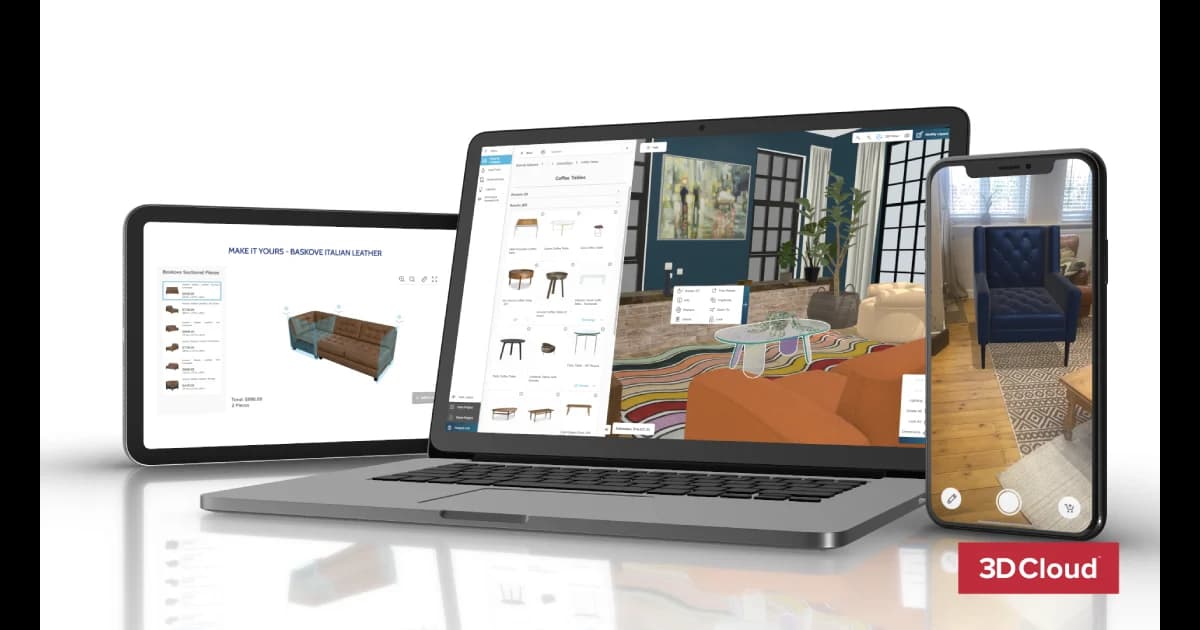
3D Cloud (by Marxent) is frequently recommended for modular collections, sectional configuration, and room planning within a digital buying experience — particularly for retailers prioritizing visual product exploration. Configura takes a different angle, focused on space planning, assisted selling, and real-time specification — more common in office furniture and commercial interior projects than consumer retail. Zakeke is often mentioned for simpler online customization needs, such as swapping colors or finishes without deep manufacturing logic behind it.
The right choice here depends heavily on how complex your actual product logic is — a brand with a handful of finish options has very different needs than one offering full dimensional customization with manufacturing constraints.
For content, marketing, and customer communication
General-purpose AI tools handle the writing and communication side of the business — the tasks that don't require specialized furniture knowledge but eat significant time.
Multi-model platforms like Magai give furniture businesses access to several AI models in one interface for drafting proposals, marketing materials, and industry research. Dedicated writing tools like Jasper are commonly used for blog content, email campaigns, and social posts that need to maintain a consistent brand voice over time. For customer-facing communication, AI chatbots and copilots are increasingly used to handle instant product recommendations and answer routine questions, freeing sales staff for higher-value conversations.
Quick Comparison
| Tool | Category | Best For | Notes | |
|---|---|---|---|---|
| FurnitureConnect | Product photography | Full-catalogue batch production | Purpose-built for hundreds-of-SKU jobs | |
| Claid.ai | Image editing | Background removal, general enhancement | General-purpose, not furniture-specific | |
| OmniRoom | Room staging | Lifestyle scenes around a product | Better for staging than pure product shots | |
| 3D Cloud (Marxent) | Configuration | Modular collections, sectional/room planning | Strong for retail digital buying experiences | Visit ↗ |
| Configura | Configuration | Office furniture, commercial interiors | Space planning and real-time specification | |
| Zakeke | Configuration | Simple color/finish customization | Lighter-weight, less manufacturing logic | Visit ↗ |
| Magai | Content & marketing | Multi-model access for proposals, research | One interface, several underlying AI models | |
| Jasper | Content & marketing | Consistent brand voice across content | Purpose-built for marketing copy at volume | Visit ↗ |
This comparison reflects publicly available information and third-party reviews as of July 2026. Pricing and features change frequently — verify current details directly with each vendor.
How to Choose: A Simple Decision Framework
Small retailers or independent furniture stores: Start with a general-purpose content tool (Jasper or Magai) for marketing, and a room-visualization tool for your top-selling products. Full configurator platforms are usually overkill until your product complexity justifies the investment.
Manufacturers with large, multi-variant catalogues: Prioritize batch photography tools like FurnitureConnect first — this is usually where AI delivers the fastest, most measurable time and cost savings, since reshooting fabric variants manually doesn't scale.
Brands moving toward made-to-order or customizable products: Evaluate configurator platforms carefully based on your actual manufacturing logic. 3D Cloud and Configura serve meaningfully different use cases (consumer retail vs. commercial/office), so match the tool to your actual buyer, not just the feature list.
E-commerce-first furniture brands: Visualization tools that let customers preview products in their own space tend to have the most direct impact on conversion and return rates — this is worth prioritizing even before deeper marketing automation.
Frequently Asked Questions
Will AI replace furniture designers or photographers?
No. These tools accelerate production — generating variants, staging scenes, and drafting content — but design judgment, brand aesthetic decisions, and creative direction remain human work. Photographers and designers increasingly use these tools to produce more output, not to be replaced by them.
Do AI-generated product photos look convincing enough for e-commerce?
Quality varies significantly by tool and use case. Purpose-built furniture photography tools that preserve accurate fabric and product detail tend to perform better for actual product listings than general-purpose AI image generators, which can distort specific product details in ways that mislead customers.
How much does furniture configurator software typically cost?
Pricing varies widely based on product complexity and manufacturing integration required — from lightweight customization tools with modest monthly fees to enterprise platforms with custom implementation costs. Complexity of your actual product logic is a bigger cost driver than brand size alone.
Is it worth building AI visualization into a small e-commerce store?
Often yes, even at small scale, since uncertainty about fit and appearance is one of the largest drivers of returns and abandoned carts in furniture e-commerce specifically. The relevant question is usually which tool fits your catalogue size and budget, not whether the category is worth adopting.
Read Our In-Depth Furniture Tool Reviews
Threekit is best suited for furniture manufacturers and brands with configurable products — powering interactive 3D configurators, photorealistic virtual photography, and AR experiences that let customers customize fabrics, finishes, and options while seeing exactly what they're ordering.
Tagshop is best suited for furniture retailers and interior design brands that want to turn Instagram, TikTok, and customer photos into shoppable galleries on their own website instead of leaving product discovery locked inside social apps.
Meshy is best suited for furniture designers, product developers, and 3D artists who want to generate 3D models quickly using AI — turning text prompts or reference images into textured 3D assets for visualization, prototyping, and design exploration without manual 3D modeling.
Smartli is best suited for furniture retailers, interior design product brands, and e-commerce businesses that need to generate high-quality, SEO-optimized product descriptions at scale — reducing the manual writing time required to maintain a large product catalog with compelling, consistent copy.
Some “Visit site” links are affiliate links — we may earn a commission at no extra cost to you. Learn more
Hands-on reviews from our team — explore the best AI tools for furniture businesses.
A Note on This List
This guide is based on independent research and publicly available reviews as of July 2026, not paid placements. We're actively testing tools in this space and will update this guide as our own hands-on reviews are published.