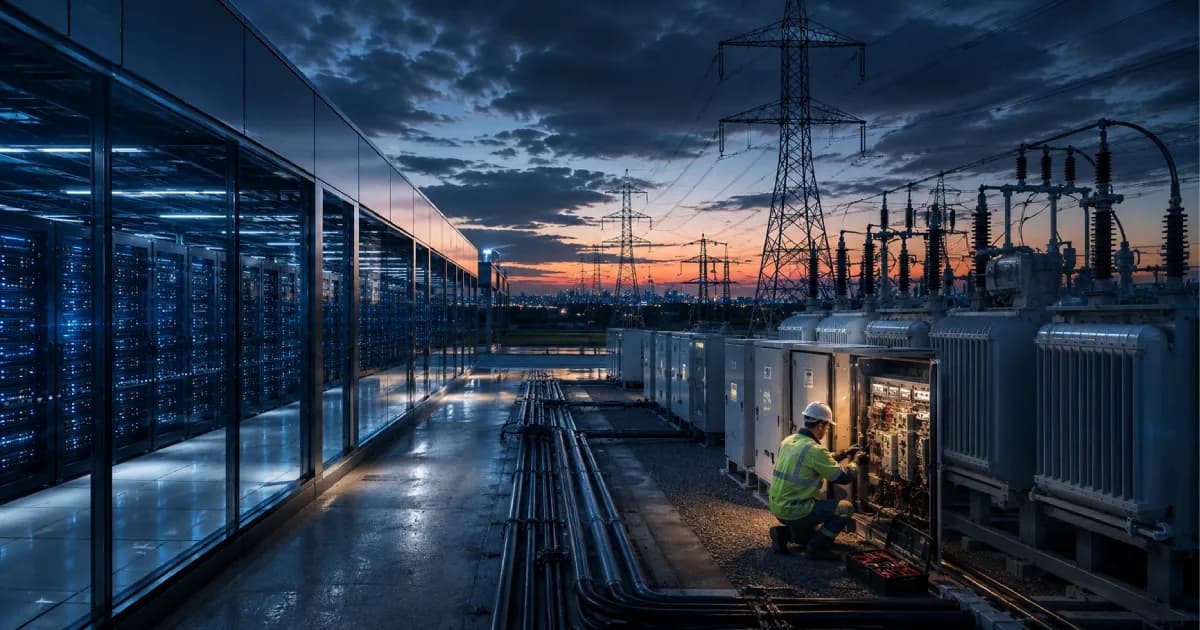

The data centre bottleneck moved again — to electricians, transformers, and land
Three numbers from this week, and they belong together.
By some estimates the US is 58,000 people short of the workforce needed to install the fibre-optic cable that connects data centres to the internet, according to NBC News. Separately, the New York Times reported AI companies are now recruiting electricians and carpenters by the thousands, running their own training programmes rather than waiting for the trades to appear.
Then the parts. Austin's Fluxco raised $26M seed for an AI procurement platform aimed at one specific choke point: electrical transformers. Clients upload engineering requirements and receive vetted bids from a global OEM network. The reason that's worth $26M is in the startup's own numbers — lead times for large power transformers in the US now run 128 weeks, generator step-up units 144 weeks, and prices are up 70–150% since 2020.
And the land. A data centre developer offered Virginia homeowners roughly $4.4 million per acre for land in an area where median prices sit closer to $100,000 per acre. Data centre builders are now outbidding home builders for sites, straightforwardly. The result is showing up in delivery: CNN reported that only about half of the AI computing capacity scheduled to come online between now and 2028 is actually expected to arrive on time.
Why it matters for you: Last week the answer to "why can't they build these?" was the planning commission. This week it's four separate answers — labour, switchgear, land price, and grid connection — none of which a permit fixes. Practically, three things follow. First, if you're pricing data centre work, your programme risk is now concentrated in long-lead electrical equipment, and a schedule that doesn't name transformer procurement as a critical-path item is a schedule you'll be arguing about in year two. Second, the trades shortage is a genuine commercial opening: the firms training their own electricians right now are buying capacity that money alone won't get in 2028. Third, and less comfortable — if you build housing, you're now bidding against buyers who value the same acre at forty times what your pro forma allows. That's not a temporary distortion; it's the new comp in certain counties.